Peter Conway: Deep Herbalism
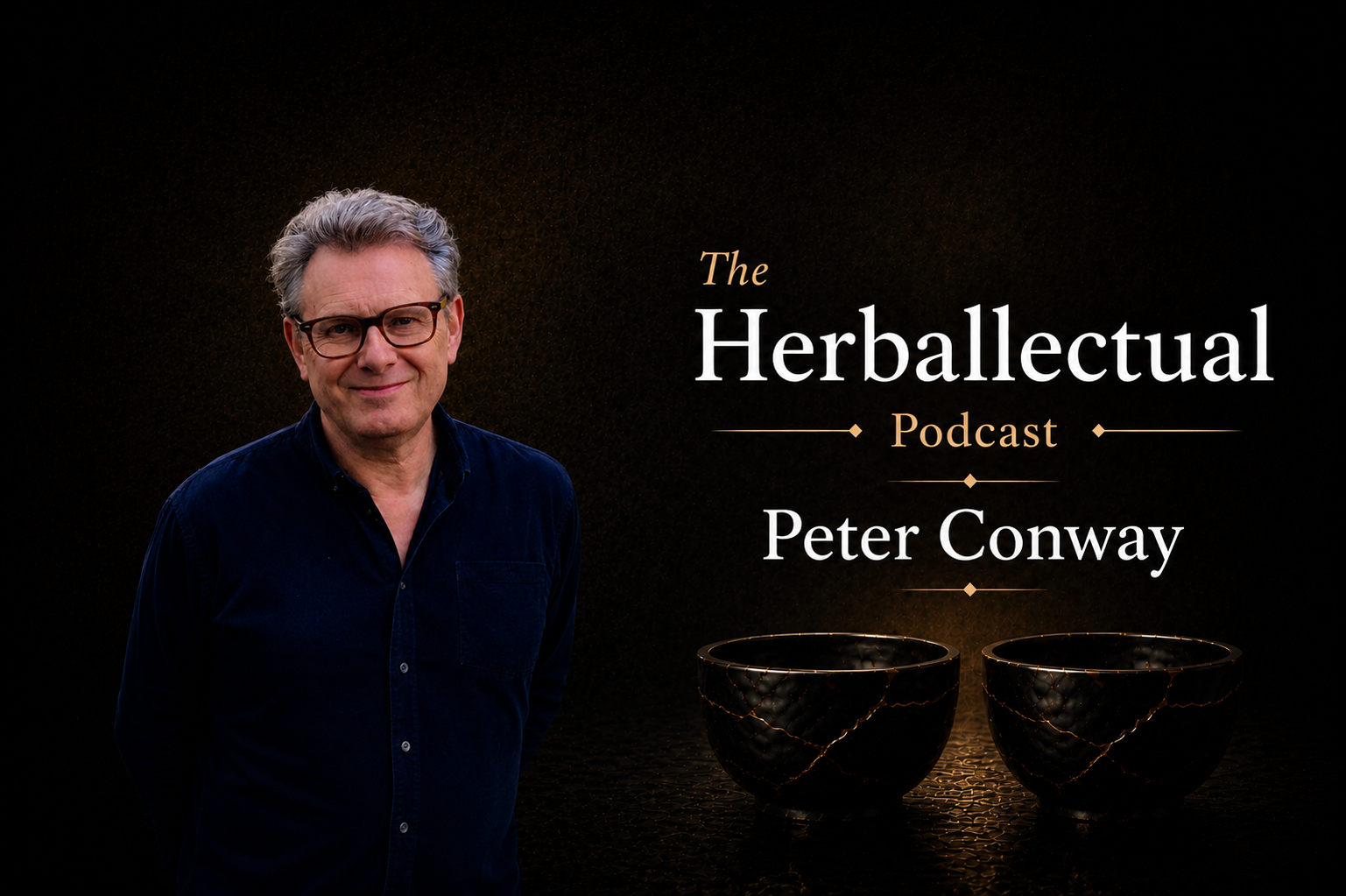
What does it mean to practise herbalism deeply, in a time of ecological unraveling? In this episode of The Herballectual, I sit down with Peter Conway, accomplished medical herbalist, educator, and author of Tree Medicine and The Consultation in Phytotherapy. Together we explore a question at the centre of his work: deep herbalism. Drawing on Arne Næss and deep ecology, Peter explores what it means to practise a form of herbalism rooted in relationship, responsibility, and the recognition that we owe our existence entirely to plants.
We speak about herbalism as a political and relational act, about reductionism and holism as partners rather than rivals, and about what is lost when a plant is reduced to a single constituent. From the consultation as its own form of medicine to the mystery that deepens the further one goes, this conversation moves through animism, humility, and the eclectic tradition's refusal to be limited by any one tradition. Along the way, Peter reflects on the relationship between science and mystery, shares a luminous account of juniper asserting itself in a consultation, and returns, again and again, to the heart of the work: loving people, loving plants, and tending the relationship between them.
Find Peter Conway
-
EP 3 Peter Conway FINAL 2
Mélanie Pulla: Welcome to the Herbalectual, a listening chamber for the living field of herbalism.
Mélanie Pulla: I'm your host, Melanie Pula, and together we are listening for the soul of herbalism.
Mélanie Pulla: There is a question gathering beneath much of contemporary herbalism. Not simply how to use plants well, but what kind of relationship we are being asked to have with them in the first place. We live in a time when the natural world is often treated as something to extract from and consume.
Mélanie Pulla: And these currents have long run through
Mélanie Pulla: herbalism more strongly now than ever. We see them in the reduction of plants to products, in simplified narratives, and in the subtle temptation to mistake information for relationship. Peter Conway has spent decades asking deeper questions as a practitioner, author and educator. For over 30 years. He has been honoured for his services to herbal medicine as a fellow of both the National Institute of Medical Herbalists and the College of Practitioners of Phytotherapy, where he served as president for 12 years. He continues to teach and refine his craft, including as a faculty member at Pacific Rim College in Victoria, bc. Peter is the author of Tree Medicine and of the Consultation in Phytotherapy, a book whose central insight is that the meeting between practitioner and patient is itself a form of medicine. This conversation moves from deep ecology to deep herbalism, through the creative tension between reductionism and holism, mystery and medicine, and toward the possibility that herbalism itself might be one way of remembering our place within the living world. I started by asking Peter what he means when he uses the phrase deep herbalism.
Mélanie Pulla: Well, deep herbalism, um, is really an emerging concept in my own psyche, Melanie. So what I really hope to do in using the term deep herbalism is to catalyze other people's thoughts about what it might mean to them. Um, and so the last thing I want to become is the arbiter of deep herbalism. So people say to me, hey, Peter, is this deep enough for you? Uh, does this qualify as deep herbalism? It's really not for me to say, but, uh, it's for me to maybe catalyze. That's my kind of idea. Um, and maybe if I speak a little bit more to the desire or the urge to catalyze, if, ah, that, um, helps, um, and to get very deep very quickly. We live in a time of genocide and ecocide. Um, ah, the intentional destruction of people and the intentional destruction of the planet. Um, by which I mean that large corporations that are destroying the planet, governments that are destroying the planet, they know they're doing it. The science on this has been solid for very long period. Of time. Um, and, um, they know that doing it. So this is ecocide, Intentional destruction of the planet. And you and I, Melanie, both have kids. Um, and I feel a responsibility to my kids. Ah, to not just my own kids, but everybody's, um, children. Um, to. Sounds grandiose, but, you know, to the people of this planet and its other inhabitants, our fellow species. Um, of, uh. Uh, animals, insects, and of course, you know, the plants, um, uh, themselves. So, as a herbalist, for me it means to be a person who seeks to understand the relationship between people and plants and everything else that weaves out of that, spreads out of that. So it seems to me there's a need for people who are interested in that focus at this time. But there's a need for us to go deeper in our, uh, focus. Uh, because herbalism, I believe my conviction has been for a long period of time now, um, herbalism is one of the key answers to how we steer the ship around and how we make things fundamentally better. Uh, but we will only do it as deep herbalists. Um, we will only do it by going very deep with these things. Um, one thing I encounter very often is, um, people who style themselves as holistic. Um, who, when I talk like this, say, peter, don't you know that it sounds very political? You know what you're saying? Um, and don't you know that holism and politics have nothing to do with each other? And let us, uh, get this foul, uh, impurity of politics out of our, um, sacred and pure, um, discourse. And I don't know that politics has nothing to do with medicine. I think politics has everything to do with medicine. To be a herbalist is a deep political act. Um, at least potentially, if we think of it as such an act that, um, seeks to change the world. Or maybe not to change it. To reset the initial conditions for the world. Maybe in its most utopian sense, but in the more realistic sense to do both. To change the world as it is. To try and conserve Samoa. Elements that need to be conserving about our, uh, relationship as humans with our fellow entities in the universe, including, fundamentally, the plant. So for me, I was inspired in thinking of deep herbalism by Ani Ness, um, Arnie Ness, the, uh, Norwegian ecologist who, um, spoke about deep ecology and the need for deep ecology. And he drew a distinction between shallow ecology and deep ecology. Shallow ecology being an ecology that kind of seeks to sort of slightly tweak capitalism, not use plastic bags and all that kind of stuff, which is not bad. It's okay. But it's not enough. It's not nearly enough. So by deep ecology, ness meant, uh, something like, um, a fundamental understanding of our relationship as humans within the ecosphere and our responsibilities as humans within that, and the deep connectedness that we have with nature. So I would similarly and non judgmentally use the term shallow herbalism and deep herbalism. So shallow herbalism. I don't mean to knock it. It's fine. Despite the analogy, if you've got to learn to swim, if you're going to swim in the ocean, you don't want to just kind of dive in, in the middle of the ocean and do some deep swimming there, because you're going to get to trouble very quickly. So you might just want to sort of paddle, uh, around the edges, just go up to your knees, uh, initially, uh, run back away, um, onto the sand, onto the beach when the waves come. But as you become a stronger swimmer, you can venture out a little bit further. You, um, can explore, you can swim to that little island offshore, um, and see what that's, uh, about. So shallow herbalism is great. It's a beginning relationship with herbs. And I see a lot of shallow herbal herbalism in the whole social media sphere. Um, uh, so much tsunami of shallow herbalism. Again, I don't mean to mock. It's great. I find it so encouraging that shallow herbalism is out and about. By which I mean, hey, here's how to make this preparation. Hey, take this herb, uh, for that. As an experienced clinical herbalist, we know it's not as simple as take this herb for that. Because our experiences that, um, you know, life and medicine are complex. But as a place to begin, you know, great. You know, but we have so much shallow herbalism, um, and, uh, not a lot of deep herbalism, by which I mean the kind of herbalism that is involved in the salvation of our, um, current status as a species in relationship to our fellow species on this planet. Which will of course sound grandiose, but doesn't sound grandiose to me. It sounds pretty straightforward, but I'm coming from a deep herbal place. Does that sound, um, alpha?
Mélanie Pulla: Yeah, I think. I mean, there's so much you said there that I want to dive into. The first thing that resonates is that this is very much an ecological, kind of interconnected, relational aspect to our environment and our living world. And in doing so, it's a very active process as opposed to that kind of like spiritualism, very passive, kind of. We don't, we don't want to like, stir any uh, challenging emotions or anything like that, but. But more having that active forward movement, intentional kind of practice, you know.
Mélanie Pulla: And I think to, you know, to challenge what you kind of may be hinting at the currents in. So called. When I say so called, because I don't think it really is. I think it pretends to be holistic medicine. Things that we have, you know, words for phrases, for toxic positivity, um, spiritual bypassing, uh, magical thinking. Not that I don't think that there's magic in the world, but I'm talking about a deeper magic. A real gritty, earthy, uh, profound. Ah, magic. Not a, you know, again, a superficial one. Um, so, yeah, challenging the sort of tenets by which holistic medicines are called has avoided engaging with the deep, deep challenges of hard times. So to be able to dive into those deep challenges, not to stand outside of them, is really the key thing to do, I think now for herbalists. And the thing is, we can do it. The herbs can go there. The herbs can go anywhere. The fundamental place I start from is the herbs were here before us. They were here way before us. They created the initial environment in which we could arise as a species. And all our fellow, um, species. The plants are the fundamental foundations of things. They set the initial conditions for our emergence as a species. To use the language of complexity theory. And by resetting the initial conditions for human being, the key place we can look to is where we began. We began with the plants, we continue with the plants. But in creating, uh, a sort of more superficial spiritual bypassing approach. I mean, that doesn't really cut it. It doesn't really take us a. You know, my calling to herbal medicine, my path to herbal medicine really began with me seeking a, uh, career path, um, that fitted what I would have called in my teens. My green values. And those green values are still profoundly there. So I begin from an ecological, um, drive and perspective. A, uh, perspective of, um, conserving, uh, relationships in nature and sustaining relationships in nature as our ancestors have always done until recent times. Um, uh, and then Hubble medicine, um, really opened to me as a path, as a key practical path, um, of ecology, um, of sustaining relationships, um, within the world with individual patients, with students, but with the broader kind of scope of, uh, the herbal influence we can exert, um, in the world. But in a very sort of earthy way, in a very mundane way. One of the things that excites me the most about herbs is how mundane they are. And by mundane, I don't mean boring. I don't mean Dull, mundane means of the world, of the everyday commonplace. And Gabrielle Hatfield, the, um, ethnobotanist, um, calls our basic relationship with herbs in the day to day domestic medicine. So we need that to return that domestic medicine where it serves its purpose. But we also need specialists in herbal work, um, to go to deeper places this as we need to as well. Does that make sense?
Mélanie Pulla: Yeah. And I love so much that you talked about the mundane as something of value. Right? As something, I mean that's actually my tagline for my business is, you know, infusing magic into the mundane. Because I, I think the mundane is so rich when you can actually like really settle into it. So with everything you've said, like I'm hearing that there's a, there's a real relational kind of heart to deep herbalism. Do you feel like that herbalism in general is inherently relational?
Mélanie Pulla: Yeah, I mean, one way of sort of framing how I think of that relational piece is, um, if we think about original human experience, if we think about ancient peoples, uh, pre agricultural peoples, indigenous peoples, um, relationship with the world, we can say that it inherently has certain features. It is animistic in uh, the sense that everything is alive. So everything is alive. Mountains are alive, the ocean is alive, stars are alive, people, um, are alive, other animals are alive, insects are alive, uh, plants are alive. But what we often think of in one world as inanimate objects are animate, they have animus, they have, ah, life in them. Um, so I think the original worldview, as far as I understand it, is inherently animistic. Everything is uh, alive, but also everything has mind, everything has spirit. And one word for that that's used these days is panpsychic. Um, there is, um, you remember psychology means study of the mind, but psyche with an e was the origin of that word. Psycho, that means a salt spirit. So the panpsychism, um, everything pan meaning across, across everything across everything in existence. Everything's alive and everything in existence has mind, has spirit, has soul. And then we could say the third aspect of that ancient worldview is kin centric. Um, which is right back to what you asked about relationality. Everything is related, everything is kin. Uh, everything is, uh, family. So my basic viewpoint is everything in nature is alive. Um, everything in the world, everything in the cosmos is alive. Everything has mind, it has spirit, it has uh, being, um, it has soul. And everything is related, everything is connected. So is herbal medicine essentially a relational practice? It's at the heart of everything I just mentioned. Our relationship with plans is our key relationship Sometimes, um, post some really basic thought experiments, um, when talking about hebble M medicine. And one thought experiment, uh, don't think about it too much, because it's a terrifying, terrifying thought that I'm going to open up here. But what if. What would happen if all the planets on the planet disappeared right now? Every single plant on the planet disappeared. If they all went right now, what would happen? We would die. How quickly? I mean, how long can you hold your breath? And sometimes I'll use a thought experiment like that, which doesn't take too much thinking about and is blindingly obvious. It's a no brainer, um, in terms of thinking into that one. With people who are having difficulty, the idea of thinking like, well, you know, hang on. Like, we have this relational kind of dimensionality with plants. I mean, I know they look pretty and, you know, some of them smell nice, and if some of them taste good, you know, but beyond that, um, but beyond that, we depend upon them for everything. For everything. We would not be here without them. We would live for as long as we can hold our breasts without them. You know, this is, for me, irrational point, you know, which leads to a spiritual connection. But it's fundamentally a rational point, you know, that we would. The plants were here first. We would be nothing without them. We can't survive without them. Act accordingly.
Mélanie Pulla: And so when you talk about this shallow versus deep herbalism, which I totally relate to and can also see very clearly, but would you call that like an extractive relationship with herbalism to be. To have this kind of shallow, you know, maybe Instagram ready, kind of like, uh, you know, surface level style relationship? Do you feel like there's something that is extractive with that, where you're taking from the plants without being in relationship with them? And if so, what does that cost, you know, herbalism?
Mélanie Pulla: Well, you know, I know this is a term that you use, Mellie, so I was curious to see how you defined it, but I think you just did, you know, like, kind of extracting, like taking something. You know, here's one thing, um, that annoys me. Uh, although, you know, in the broader scope, I kind of understand. It's just kind of where we're at at the moment. But I'm not sure it's where we might best be. This tendency to refer to plants by their constituents. This happens a lot in naturopathy. Naturopaths don't at me, but I think you need to look at this. So I'll see an Instagram video of a naturopath saying, you know, you don't need GLP1 drugs. There is a herb, um, that can replace the GLP1 drugs, and that herb is called berberine. Well, berberine is not a herb. It is a constituent common to several herbs. And to talk about in terms of being a substitute for GLP1 drugs is just oversimplifies, uh, what is a very complex, um, area. So I think that crass oversimplification of our relationship with plants. It misrepresents the plants. And we should be, you know, we should be concerned about that because we owe our existence to plants, so we should not misrepresent them. Um, but it also misrepresents her medicine. You know, a deep hermesin would be substantially more precise and complex. You know, um, in its approach, there is no plant called curcumin. It is constituent. There is, by the way, no plant called psilocybin. Um, it's a constituent. There's no mushroom called psilocybin. It's a constituent. So people tell me, you know, I'm microdosing with psilocybin. I'm like, are you actually microdosing with pure psilocybin? Because that's a little bit different to, you know, microdosing. Ah, you know, a small amount of a whole psilocybin mushroom, um, species, um, extract. So I think in that way, and using the word extract there, uh, yes, extractive. Trivializing, misrepresenting, misinforming, um, about plants representing a constituent as if it was a plant, really. So shallow herbalism, um, I don't want to belittle because I think we need to take baby steps when we're getting into big areas. And herbal medicine is a big area, and we need to swim in the shallow end before swimming in the deep end. So shallow is good. But misrepresentation, trivialization, that doesn't serve anybody. Um, it's just a way of jumping bandwagons and that kind of stuff. Trending. Herbs don't trend around us. We trend around herbs. We are trending phenomenon of plants. Um, maybe look at it that way.
Mélanie Pulla: Yeah. And I feel like what you're touching on is really the reductionism of herbalism, which happened, I think, to legitimize it to become. To grant the seat at the table that was previously closed to it, and now we've done that. Ah, so do you feel like there's still a legitimate rule for reductionism, or was that, um, an era that we've moved beyond?
Mélanie Pulla: There's definitely a legitimate role for it. Um, reductionism is immensely Powerful, it's immensely insightful, but also it's immensely dangerous if we um, remove it from context. So the way I see reductionists, John Tyler Bonner, who's a biologist, said, it always baffles me why one cannot be a reductionist and a holist at the same time. And I actually would go further and say to be a true holist you must also be a reductionist. Because if you're saying I'm holistic and I reject reductionism, then you're not holistic. You're rejecting a part of the whole. Reductionism is a part of the whole. Uh, the way I think about it it's kind of zooming in. But if we zoom in, there's an old phrase, you know, the devil's in the detail. We can get lost in there. Uh, and M, you have to be able to zoom out to put the detail into the big, big picture. So reductionism is fantastic. We've learned so much from reductionism. Reductionism is incredibly important, but it does not have to be separated from holism. And holism, a true holism cannot separate itself from reductionism. So we often find, uh, in my view, um, discuss. There's much to discuss and lots of counter opinions there. But a holism that rejects reductionism and just says m having nothing to do with that is in my view just not serious. You can't discount the power of reductionism, but you can contextualize it. One of my big influences has been the British um, philosopher Stephen Toulmin. And Tulmin wrote a fantastic book called Cosmopolis, the Origins of Modernity or something like that. Cosmopolis is a key um, uh, title, um, and Tulmin said that the so called scientific revolution going back to the 16th century was successful in that it rendered everything that was studied independent of context. So rendering things independent of context is reductionism and it has great power. Um, you can look into laws of gravity and all that kind of stuff in doing that. But holism is really putting things into context, but we need to put the details into the full context. So reductionism, holism, yin and yang, they're two ends of the spectrum. And the true holist, um, will delve into reductionism, but put it back into the whole content. Like I said, that example of you don't need GLP1 drugs, um, just take Berberine. That's reductionism. It's reducing a, ah, group of plans into a single constituent. And the thing that is uh, offensive about me is that it parades as if it was holism. Hey, we're using a plant. No, you're not. No, you're not. Um, and you're misrepresenting plants. You are anti holistic. Um, reductionism is not anti holistic. Reductionism is looking at details. Um, the holist puts the details into a context. So contextuality, putting things within context, I think is really the key goal of holism. Um, including reductionistic details. So I don't think it's a battle. I don't think it's an either or, it's an and. And, you know, put them, um, together. And the easiest thing to do is to say, I'm a holist. And I'm against reductionism. I'm a reductionist. I'm against holism. I mean, enough, you know, we're not at war here, you know, enough, enough, enough. Where there's conflict, um, let's put these things together and, uh, let's see the relationship that they have between each other. Each pole is relevant.
Mélanie Pulla: Where would you say mystery falls into all this?
Mélanie Pulla: Mystery is partly what we don't know, right. But which we might discover. You know, one way of putting it is that, uh, you know, we just don't know what we don't know. And that takes you into mystery. We can't know exactly what we don't know. We can be pretty sure that we do know that there are things that we don't know at this stage. So we're in the kind of Greek tradition of skepticism there where, you know, it's hard to know anything, you know, for sure. So that should breed a humility. You know, we can be pretty sure that with the. Lots of things that we don't know, you know, if I think about myself as a herbalist beginning, you know, I went into College in 1990 to where I am now, I know a lot more things than I did, you know, 35, 36 years ago. But I increasingly know there's so much that I don't know, you know, as well. So the mysteries in that. Right. You know, and mystery is humility and it's wonder. Uh, and that's where the true spiritual kind of hierophany is, I think, you know, in knowing that we don't know, but being open to discovering, that'll be one way of thinking, you know. Do you have a relationship with that word?
Mélanie Pulla: Um, well, not one that I can articulate very, uh, succinctly. But I think that there's a felt sense that we have an inner knowing and that is in relationship with mystery. Don't necessarily know why we Feel that or why we know something. And I wonder about how reductionism can render that maybe, uh, inadequate.
Mélanie Pulla: Yeah, I think it can only go so far.
Mélanie Pulla: Right?
Mélanie Pulla: So as I understand it, you know, people who study, uh, scientists who study consciousness, for example, find it very mysterious, um, to the point of saying, hey, if you put somebody in, uh, an MRI scanner, you do a functional MRI and you get them to feel certain feelings or think certain things or solve certain problems and so forth, you can see which part of the brains become active. So you can see that the hippocampus becomes associated, uh, with retrieving memories and so on forth. But then, you know, how does it do it? And what is memory even? And is it stored or is it downloaded or is it recreated or is it, you know, Uh, a lot of people who study consciousness at the scientific level say we may never be able to answer these questions or some things that the details of which may be unknowable. One question would be, why do we want to know those details? You know, can we be content to not know? You know, that's another thing about, I think, a relationship with mystery, to be content with not knowing. Who said the human being was the perfect instrument for knowing everything in the universe? I'm not sure that we are, although I think that might be part of our, you know, our, uh, telos, you know, our drive, you know, um, to do that. Um, but we have limitations. So being comfortable with mystery, I think is key. How terrible would the world be if we understood everything? It would be unlivable. Um, it would just not be worth living in such a world. It would be so tediously predictable. So mystery, something maybe we should, um, cherish. Um, there's a, uh, GP in the UK a few years ago, um, David Grieve, who wrote a book called Mystery in Western Medicine. And he reflected on, as a very experienced general, um, practitioner that often he did things which he had not learned in medical school. And he had an instinct or an urge to explore something or say something or take an approach that he had never been taught. And I think all experienced practitioners know that kind of feeling and sense. And whether we call it intuition or whether we call it an emergent property or as I would tend to do, the emergent property piece. Uh, I think these words, these ideas are great portals into thinking, into what are the realities of, uh, practice. If you're doing it right, if you're doing it well. I think over time perspectives emerged that you didn't learn in school. Um, and I think every experienced practitioner worth a Salt would tell you that there is a real mystery to the practice of medicine. And sometimes it's best not to overanalyze it. Just let it be. Just, um, let it be what it is. But I think somebody said, I'm not quite sure where I got this from, but there is like an ouroboros, the snake that eats its own tail in alchemy, right? So the, the deeper you go into science, the more you're going to find mystery. If you think about quantum physics. And the deeper you go into quantum physics, as Niels Bohr, the theoretical physicist, said, um, if you have understood quantum physics, you have not understood quantum physics. Um, so if we go deep into quantum, we get deep into mysteries. The deeper you go into science, the more you get into mystery. But the deeper you go into mystery, perhaps the more you get to science, you can say, ah, ah. You know, there are some pieces here that make sense. Um, and you can talk about what is intuition, for example, a lot of people refer to this kind of mysterious process of knowing as intuition. There's a lot of literature on, uh, intuition. And intuition is maybe not something that comes from nowhere, out of the blue, but is, uh, embodied experience or the emergent patterns that spiral out of embodied experience. That's the way I tend to think about it. You don't really get intuition without putting the work in. You don't really get it to be intuitive from hanging around, although hanging around has its place. Um, uh, but, um, you get to be intuitive through wrestling with, um, concepts and then leaving them. Being and being content with the mystery and being content with uncertainty and being content with not knowing. And in that space that seems to be when then deep annoyance come through, you know, um, at what we might call the intuitive level. But I think it comes out of a struggle to understand, you know, at least for me, that seems to be how it is.
Mélanie Pulla: Do you feel like there's a disconnect or a difference between how herbalism is practiced in the experienced practitioner, how they actually practice it, versus how it's taught?
Mélanie Pulla: I mean, there might be. I don't think any of these things are inevitable. I think ideally, yes, there would be, but I don't think it's inevitable. You know, just because you've been a practitioner for a long period of time doesn't mean that you're learning anything or getting any better at what you do. You also have to be committed to reflective practice and to pondering and to entering into the challenges that you are given. Um, Thomas Scoffholt, who wrote A fabulous book I would recommend to any practitioner called the Resilient Practitioner said that there is true development and there is pseudo development. So I don't know if you've ever come, uh, across a practitioner or somebody in the herbal field or any other field who's been around in it for a long time. And they purport to be very knowledgeable. And you're like, I'm not sure that you are. Just the fact that you're around for a long time doesn't mean to say you get deep development. You might get pseudo development, you might get fake development. Um, the scoffer says the only way to get true development is through a commitment to reflective practice. Um, to reflect on the challenges and to reflect on the things that didn't go well as well as the things that did. Um, so after a consultation, I might reflect and say something was off there. What was it? You know, I missed something there. What was it? There was something I needed to know and I didn't get to it. What happened there? Ah, what did I not see? Um, what do I need to learn from this? And I think if you have a practice like that, where you committed to reflection, think, certainly, um, you can develop over time. And ideally, you know, after, say, 20 years of practice. If you're just practicing in exactly the same way that you were taught at school, I mean, you might want to go back to school and restart, I don't know. Because, um, the key satisfaction of being a practitioner is integrating, innovating, developing, coming to your unique, um, approach. And I think herbal medicine as a practice is so highly symptomatic to that. And I often put it this way. Can we ever fully know ourselves? Can we ever fully know another person? Can we ever fully know a plant? Just when I think I really understand a plant, it shows me another side to itself. Just saying, when I really think I understand somebody close to me or a patient I've been seeing for a while, they show me another side. So I'm always open to that. And maybe that's part of the mystery thing. Open to the mystery, you know, of that, um, as well. So for me, the key path of the herbalist is one combining tradition. So I would consider myself to be an eclectic, um, herbalist. And of course, there was a group of, um, herbalists, we. Or herbal physicians we know as the eclectics. I think, um, that word is still relevant. As I understand it, the eclectics themselves, they didn't want to be limited by any one particular approach. They were using European herbal medicine, the Conventional medicine, such as it was, as it existed in their time, the new science, such as it was, that was emerging, um, drawing upon, often unfortunately, culturally appropriating, but drawing upon indigenous wisdom, Native American plants and so forth, but not being limited by one. Um, uh, approach and eclectic comes from the word eclectos, meaning selected. For me, the richer herbalist is one who knows a lot about different traditions and approaches to plants, different ways of working with plants, scientific ways, traditional ways, et cetera, et cetera and probes. There's a relationship between those things, um, and can select from your range of knowledge to suit the needs of a particular patient that you might be, um, uh, working with, particular client you might be working with. I think in that way your initial training is just a starting point. And then you sail your own ship and go to whichever waters you need to go to, um, and utilize whichever concepts, um. M. You might feel relevant, um, to you give you an example. I'm trained in Western herbalism, physiotherapy, whatever we call it, not in Chinese medicine, but I know a bit about Chinese medicine. I know a bit about Ayurveda. I know um, a bit about all kinds of approaches, traditional medicine through my studies in ethnobotany, my self studies and all kinds of varies. And if I feel that I can offer a perspective coming from any of those eclectic pieces to my patient, I will uh, I won't limit myself to being a western herbalist. I think that term's problematic, um, anyhow, so I don't have to limit myself to what I was learned in school. I can add to after that. The concept of the lifelong learner becomes relevant here. That's really where the real juices and the joy.
Mélanie Pulla: You were talking a little bit about, um, essentially contemplation and the importance of having this pondering, this reflexive approach to practice into herbalism. What role do you feel like contemplation, um, has in herbalism? Do you feel like, is it something that we don't do enough of to really contemplate the foundations that we're working with, the frameworks we're working with, why we're making, the choices that we're making?
Mélanie Pulla: I don't know is the answer. I can speculate. I don't know because I don't know what every herbalist is up to. And. And I think there are very many hublists out there who are quietly helping people, um, and doing that contemplative work, um, and they're not published and they're not speaking at Conferences and they're just getting on with the work, um, and doing an incredible job. And we may never hear from them in their communities doing their thing. Right. There's always a justification for that content contemplative piece, um, coming right back to the word medicine itself. So the word medicine. Selma Sharon wrote a paper in the 50s looking at the etymology of the word medicine. She was, ah, a librarian, a very elite librarian, librarian. And very few people have attempted to look deeply into the etymology of the word medicine. But she traces it back in the sort of Greek root to uh, words relating to middle. So medicine means to be in the middle and medicine relates to words like medium, middle. So social media is in the middle between what we put on there and who receives it. Um, and uh, medicine also relates to words like to mediate and to meditate and so meditation, contemplating the contemplation of what is happening with this person. What might I offer to them that helps? That's the core of medicine, you know, do sober medicine. That's the core of medicine is to mediate and meditate and contemplate, to stand in the middle between, you know, in Chinese medicine we might say between heaven and earth. Right. The Chinese practitioner stands between the knowledge of heaven and the way that the knowledge of heaven can be applied on earth to the particular predicament of a person who is struggling, who comes to consult your uh, help. Um, so there is a very grand, you know, deep piece to that. But we stand in the middle between the patient and their challenge, trying to offer them some resolution, uh, between the two. So really to medicine means to be in the middle, to remediate is where the word remedy comes um, from. By the way, I always recommend the study of etymology as a, um, study of magic. Um, back to what we say about mystery. Etymology is a profound portal into mystery. Look at the origins of words and what they really can mean as opposed to what we've construed them as meaning in the complex. So contemplation is key to the qualities, the competencies, um, of the practitioner of any field of medicine. And if we are simply regurgitating what our teachers have told us or um, obeying the rules of our uh, model, um, then we're not in the best place. I think Michael Hyland, who I studied with a little bit, yeah, gosh, quarter century ago and I did a postgraduate study in the UK around the turn of the millennium and Michael Hyland has this theory, um, called entanglement theory. Entanglement as a positive sense. And Michael says That really what's happening in medicine is that there's an entanglement between the practitioner, the person they're working with, um, and the tools that they're using. Um, so what we should seek, I think, as herbalist, is to be ever more deeply and complexly and mysteriously and emergently entangled with understanding people and plants. And the key thing to be a herbalist. I think to be a herbalist, um, you must love people and you must love plants. If you don't love people, uh, if you don't love plants, you're not in the right place. Uh, if you love one of those but not the other, um, humans can be challenging, but ultimately we've got to find a place of love. Loving people and loving plants, and contemplating what that means in this moment. That's maybe the key contemplation. And, hey, maybe that's the deepest piece of deep hubble. Um, perhaps loving people and loving plans and seeing what that means for us in this moment, in this moment of. Of genocide and ecocide and this moment where the toxic infrastructure of the world is being increasingly revealed to us. Uh, Epstein files, um, et cetera, et cetera, et cetera. Um, uh, and definitely et cetera. Not just that, but many other things. We do live, I think, in the time of the Antichrist and the apocalypse. This is where we are, and we should be damn straight about it. The Antichrist is here. And anybody who behaves. And there isn't just one Antichrist, there are many. Choose your own Antichrist. But anybody who, um, behaves in an opposite way to the idealized model of a deity is the Antichrist. And we live in a time of the Antichrist having power. Um, we live in a time of apocalypse. Apocalypse meaning not the end of the time or the end of ages, but apocalypse means unveiling, revealing the world we're living. The toxicities of capitalism, materialism, colonialism, sexism, racism, ageism, all those kind of things is being revealed to us. And this is a time to decide which side you're on. I'm on the side of people. I'm on the side of plants. I'm on the side of nature. Uh, E.O. wilson, who wrote a book called, uh, biophilia. Um, the love of nature and the larger love of life. Um, but there's also biophobia, uh, hatred and fear. M of nature. And ecocide happens through biophobia. Um, so deep herbalists can offer roots into biophilia. I've called it nature philia more broadly, and nature, uh, phobia. Um, but that is the relationship piece. Um, can we help people who are caught in the grip of nature phobia, biophobia? Can we connect them with nature? Philly, with a love of nature, with a sense of belonging in nature rather than nature belonging to us. And a deep take on that is a lot of the fall from grace with God. To stay in my liturgical metaphors, I think, is the shift of, um, pre agricultural peoples into agricultural peoples. So that prior to agriculture, um, beginning Sufton said back 12,000 years ago in Fertile Crescent, the Nile Delta, and gradually spreading around the world from then would be the standard story before agriculture, we knew ourselves to belong to the earth. Uh, post, um, agriculturally, the earth belong to us. And that's the fall from grace with God, and that's the nature phobia position we're in. Um, so there is a piece about recovering a sensibility at connection with the world that was here before agriculture. So recreating, rewilding, uh, the current phrase, relationship with nature in that kind of way becomes key. And, um, who better than herbalist to help us into that, um, place? That's another piece about the berberine. Berberine is a, uh, colonial mindset. If we take berberine out of a plant, we give people berberine. If we give people curcumin. This is a colonial mindset. It's to say that the plant itself is not good enough. Nature itself is imperfect. What you must do with nature is back to your idea of the extractive. You must extract the essence. Um, it must be filtered by humans. Uh, then it belongs to a Zenith sars. And that's why I'm so deeply offended when I hear supposed naturopaths on Instagram say, this plant Berberine. And just question the colonial mindset that you're speaking with here for a moment because, um, this is not gonna lead us anywhere good unless you do.
Mélanie Pulla: Yeah, well, and I can really relate to what you're saying that, you know, we are in a time that is one of great revelation, where things are really becoming apparent in ways we didn't expect. And in a way, it makes us at a threshold right now. And therefore, by extension, herbalism is at a threshold and at an inflection point, um, where it does have this almost responsibility, but one could say, opportunity to really serve in greater capacity at the depth you're talking about. Ah. And so you wrote a book. In it, you discuss, like, the consultation as a therapeutic factor. Am I correct with that? Yeah. And so that the encounter itself is
Mélanie Pulla: part of the medicine 100% without the encounter, the medicine is going to be very limited. There's a piece in one of um, Plato's um, writings where he writes about um, there is a plant and if you say the charm with the plant it has this great power. But if you offer the plant without the charm, it doesn't have much power. So the consultation, the interaction in having the medicus, the medical practitioner stand in the middle between the plant and the patient is key to activating that channel, opening the channels for the plant to potentially um, enter. Um, there's a saying that I think something like this. Elliot Cowan, I think, ah, said in his book on plant spirit medicine and Ellie I think said something like this, that the plant heals the patient as a favor to its friend in dreaming the herbalist. Now there's some mystery in that one. So I've been thinking about that one for years. I uh, still haven't resolved it. But the plant heals the patient as a favor to its friend in dreaming the herbalist. Um, so we make a connection with the plant on behalf of the patient to make an introduction between them. Um, I think Chris Headley, herbalist in the uk said that herbalists are matchmakers, uh, between people, uh, and plants. But there is huge part of the consultation and the interaction between patient and practitioner around the plants and the entanglement again of all that patient practitioner plan within the consultation that without it, um, if you look up on the Internet, um, hey, you know, I should take this hub, uh, for this thing that I've got, or you ask the A.I. god forbid, uh, you chatgpt it. The chatgpt does not have that entanglement, you know, that a human being has. And you may get some benefit from such an interaction. But it lacks depth, it lacks complexity, it lacks mysterious medical um, power. The mysterium tremendum, the tremendous mystery that lies latent in the world that we as initiates of medicine, um, may help to herald the patient into. That is all kind of uh, lacking. But the consultation is um. Ronan Jacobs, two psychotherapists said that um, there are three modes of being, um for a practitioner. There's the instrumental mode. And we tend to identify with the instrumental mode. So we say I am a herbalist, I am an acupuncturist, I am a whatever. And we as practitioners, we tend to associate most with our instrumentality. And of course we are using herbs as tools, we're using them as instruments. But there is also Ron and Jacob say, um, there's a therapeutic mode of being. There's the instrumental mode associated with my tools, um, there's a therapeutic mode, which is everything that goes on around that entanglement of the connection between the patient and the practitioner and the plan. By the way, I realize when I say patient this is coming from a very British medical, herbalistic point of view and M, we sometimes have issues with that word. Um, in North America we might use client or something like that. So substitute words if you need to, folks. Then there is a third mode, um, which they call the transpersonal mode. Um, and this is momentary. And it doesn't happen all the time, but in dialogue with another person. M. Sometimes we're no longer a practitioner, they're no longer a patient. Um, and the facade of all that drops and we have a moment of mystical union between us and it's usually momentary and it's best just to acknowledge it and not hold onto it and just let it move on. So the instrumental mode we can thinking about our herbs with a patient can be involved with that much of the time. The transpersonal mode we're in at odd moments here and there, very occasionally there's a meeting of souls that occurs, a resonance from that. But the therapeutic mode we can strive to be in all the time to be therapeutic in our approach to the other, such that we create the initial conditions for the potential emergent properties of the interaction between the patient and the plants to arise, to come through. And without that sort of scene setting and ushering in, um, and establishing of connectivity, the channels are not really open for the plants to do their most. So the person of the practitioner is very important in this, uh, not that we should get egotistic about it, we should be very humble about it because it's a very daunting and humbling position to be in. I often disagree with a lot of so called holistic medicine tenets. Um, um, and one of them is often the practitioner will say when patients make progress with treatment. Um, practitioners often say to the patient, when the patient says, you know, thank you very much for your help, um, practitioners tend to say something like, oh, you know, you did the work, not me. You know, the plants did the work, not me. This is false modesty, I think, you know, um, you did work, you had to do work to connect the patient with the plant. Sure the patient did the work. Sure the plant did the work. Maybe they did most of the work, but you did some of them that. And if we say, oh, it wasn't me, it was you and it was a plan, so I had nothing to do with that. Well, why on earth did they come and see us in the first place? And it's ridiculous. So not egotistically, not vaingloriously, but with modesty and with humility, but with seriousness. You aren't doing the work, so do the work and do it well and reflect and learn and learn from the things that are most uncomfortable because they tend to be the greatest teachers. Don't hide behind positive thinking and. And positive toxicity, rather, um, and spiritual bypassing and all that kind of stuff. Um, wellnessism and ableism and healthism and all these kind of things. By the way, if anybody is listening to this who doesn't know terms like healthism and ableism and worth, uh, looking them up and getting a perspective on
Mélanie Pulla: them, when you discuss that kind of consultation process and the three modes and how that transpersonal mode is maybe the most ineffable of them all, where it's hard to really name it and understand it even. Perhaps. What I'm hearing was that the instrumental mode is using the herbs as an instrument. Is that correct?
Mélanie Pulla: Yeah. I mean, that might sound a little bit crude, but to use herbs as tools, a tool is, uh, something that helps you achieve an end. So if we're, as herbalists, we're using herbs as tools, not to insult them or reduce them by calling them tools, um, but to say that they are entities that we use to an end, you know, as a means to an end for the patient. We can use other terms as well, but the instrumentality, uh, the things that we work with to try and cause change.
Mélanie Pulla: And the way you say it is very clear that it's a very deeply relational kind of process in understanding how to use them in that way. But my question is, could the practitioner also be an instrument that you tune of resonating and intentionally creating these transpersonal moments?
Mélanie Pulla: Yeah, very much so. Um, I'll give you one example, right? So I saw a patient a while ago. They had, uh, had a severe concussion, um, they had an injury and had a TBI Traumatic brain, um, injury. Um, they were sort of a year or so after the main event that had caused this injury. They were still having significant, uh, symptoms. As I listened to them and they told me their story and they told me that what was happening and so forth. I'm always, you know, as a practitioner, you're doing several things at the same time, right? You're listening, you know, listening to understand, not to respond, which is a tricky thing to do. But you also are thinking, you know, okay, what's my next question? What else do I need to ask what could be the diagnosis here? Which herbs are coming to mind? What strategies might I use? Uh, could I be recommending this patient to see an acupuncture colleague or whatever it might be? So there's a lot of kind of weighing these kind of things up. So it's a really advanced thing to do, to listen, to understand, not just to respond, um, but also to juggle all the other things that practitioners need to do to be helpful to the patient. So I was listening to this patient who came to me with this history of concussion, speaking to me. And as I, um, listened to them, juniper came to mind, juniperus communis as a remedy. But it came to mind, um, not from me, but through me, I, uh, would say, or not, or through juniper to me, m Maybe a better way of putting it. And juniper really appeared and asserted itself and said, I would like to work with this patient. As the consultation went on, and if a patient is speaking, I just let them speak. I, uh, let them talk themselves out. And this patient had, um, I just said, you know, tell me what's happening. And she spoke for about 20 minutes. And during this period of time, Juniper said, you know, I would like to work with this patient. And certainly seemed to come not from inside of me, but from outside of me, you know, but she's appeared and said, I would like to work with this client. I could help them. But more than that, um, as things continued with the consultation, uh, the room, um, turned a, sort of, had a purplish kind of, um, juniper color tint, um, to it. In fact, as things went on, juniper was really clear that it wanted to be used. And by the end of the consultation, some small juniper trees that appeared in the consulting room all around me and the patient. We were sitting in the middle of a small juniper grove that was purple colored. Now, I could see this, but the patient could not. And the patient kind of finished up after talking for 20 minutes and said, um, so I don't know if any herbs come to m mind for you that might be helpful to me. And I was like, let me think for a second. Um, have you heard of this thing called juniper? And the first thing, when you say juniper herb, as people say, like gin, you know, um, I was like, yeah, it is used there, but it's used in many, many other places. And I think this might be a herb we would work with. And I began to say, why, as an anti inflammatory, as a diuretic, to reduce maybe some of the fluid that was causing pressure. Uh, and so forth. But also, as you know, I was looking for affinities between. Between the plant and the person, you know, so juniper made it quite clear to me they felt an affinity with this. And, um, that this patient, you know, Juniperus communis, um, they grow in small little groves of communities. And this was a patient who was lacking support and lacking community. Juniper seemed to me asserted itself as wanting, being part of that community. Now, that doesn't happen to me with every consult, and different things happen in different consults, but sometimes things like that, you know, happen. Does that help at all?
Mélanie Pulla: Yeah, for sure. And I. And I know that I was listening to another podcast you did where you were referred to as a living mystic. And I was thinking that ties into the mystery, but also with having a very, I guess, British background with a very, uh, strong formation in phytotherapy and more, uh, clinical approaches to herbalism. How do you feel about that? Like, what's your relationship with that term? And how do you embrace mystery while holding rigor?
Mélanie Pulla: Which term specifically? Melody?
Mélanie Pulla: Well, the living mystic.
Mélanie Pulla: Oh, sure, yeah. I mean, that's a heck of a label to be given, isn't it? You know, I mean, try living up to that. I, um, was surprised when, uh, that particular interviewer, you know, said that. But I was also, like, I was quite pleased, go say, um, with it. So I don't know. I've got the task now of living up to this term living mystic. You know, I'm not sure what they meant by that. I definitely feel myself to have that. I have the openness to the mystic, you know, experience. And I think I just described what might be considered a mystic experience. Right. Uh, very, very happy and open. Talk about that. But I also have a relationship with that, um, you know, as you said, you know, around that sort of maybe reductive approach to plants. As much as, you know, I'm very critical of calling plants berberine. Um, I'm also very interested in looking at that berberine within the context of the whole plant. Not outside of it, but within it. By the way, I never prescribe berberine, and I never will. I never prescribe curcumin, and I never will. Um, I'm a purist. I use the whole plant. If the whole plant is not good enough, then the world is not good enough. I'm a purist, um, as well as maybe a bit of a mistake and a bit of a scientist and a bit of many, many things. I'm an eclectic, and I don't see why I should limit myself to one thing, one way of being. I don't see why any of us should limit ourselves. And if you're saying I am this and not that, outside of a moral piece, um, we should say, uh, I am not racist, I am anti racist. We should say I'm not transphobic, I'm a trans ally, perhaps whichever language we prefer. But outside of moral concerns, why limit yourself? You know, I mean, why say you one thing or another? So, yes, I am a mistake. Yes, I am a philosopher. Yes, I am a scientist. Yes, I am, you know, at me with whatever. And I'll probably say to some extent I have some of those things. Right. But you mentioned, um, uh, Mommy like, you know, the British piece, you know, and I, you know, I moved for. I grew up in the uk, in England, and moved around different parts of uh, England for 50 years of my life and then, then uh, moved to Canada about um, 12 years ago or something like that. So most of my life I'd been brought up in the uk. But we're all more than we appear to be, um, in our standard BYOGs. So for example, a very important piece to me in my heritage is my father was Irish, my mother was English, my father was a devout Catholic. Uh, my mother was not a person of faith, um, and they were able to have ah, a wonderful relationship, um, together. I think that I've realized, uh, enabled me to be a mystic and a scientist and to not find any conflict with it. My mom and dad could have faith and no faith and not have any conflict between them. I remember asking my mom. My mom's uh, 88 and she's wonderful and she's still with us and she might hear this. But one of the wonderful things about my mom, um, is she's very, um, pragmatic, very down to earth, um, song. And I asked her once when I worked this out as a kid, like, hey, mom, dad goes to church, but you don't. And she was like, it's not important. Uh, and um, so I was set a great example, I think at an early age how one can hold to apparently contradictory ways of being, um, within a relationship, um, at the same time and it'd be perfectly okay. But back to the Irish piece. Like many people similar to myself, my father left Ireland at a very young age, um, through the impacts of English colonialism into Ireland. That's part of my background. Um, the generational trauma of the Irish famine, um, and Irish colonialism is part of my background. Increasingly I realized that is a big trajectory as I get older. And the Celtic bardic mystic is very much part of my background as well. But so is the scientific training in fighter therapy. Um, you know, my training in phyto was, you know, was, was very scientific. I didn't realize how much so at the time actually. But I do, I do now and usually so within, you know, um, so called holistic medicine, alternative medicine. So I cherish both of those dynamics, you know, um, and uh, the yin and the yang of it at all. Right. So I encourage any listeners if this is helpful to you at all. Don't limit yourself, you know, um, uh, and be open to continuously rediscovering and reinventing yourself. And one of the most wonderful things you can ever do is change your mind. We often feel shame in changing our m. Minds, you know, that we should feel joy, ah, in changing our mind. You'll be open to uh, an ever increasing discovery of the self. And don't limit yourself. Don't label yourself too much in one kind of way. So the mystic piece, I embrace that term. I love that term. Um, you know, um, I enjoyed that that uh, term was used, uh, towards me, although I felt a bit of pressure from it. But I would also want to be accused of being a scientist. I would also want to be accused of being many other things, you know, as well. I'd be happy to embrace those as well. So we are, uh, you know, as Walt Whitman said, you know, we contain multitudes. Don't limit yourself. Don't limit yourself to one way of being. Don't limit yourself to one tradition of herbal medicine and embrace them all, uh, and find what makes works for you, and find what works for a particular person you're working with in a particular situation, a particular moment, uh, of time. The key to herbalism, apart from loving people and loving plants and standing in between those relationships and maintaining and sustaining those relationships for our species and our planet, is, I think it comes down to right plants, right person, right dose, right preparation, right time for the right duration. You know, those kind of rights come into the clinical decision making about which herbs to use or not use. You know, in the case of the juniper story, I told you, um, I just prescribed juniper and it helped that patient a lot. Juniper might not be the first herb we would think about for concussions, uh, for tbis, traumatic brain injuries, but it was an extremely helpful herb for that particular, you know, individual. Um, right herb, right term, right moment, right person, right dosage, right duration, add the right effects. If you can do that. It's not easy. It's Hard to replicate. But if you can aim to do that, you know, from time to time, it's where the, you know, I want to use the word magic, so where the magic happens, but it comes out of, uh, process. You know, somebody once said that magic is just. Just speak to a lack of awareness of process and process and pattern recognition is really what traditional medicine's about. Understanding the processes of nature, recognizing the patterns of nature, but then being open to understand the countless limitless numbers of variations on the theme, um, of those patterns and not to be held to linearly. They shift and change and develop and morph and mutate into flux, into many different manifestations. That would be my thinking of it. Where is this taking as another.
Mélanie Pulla: Yeah, well, I mean, do you feel like when you're working with these multitudes, there's a conscious or maybe even unconscious, but that you can tease out a shifting of mind frames, like moving away from the analytical mind, perhaps, and knowing you can go back there, uh, when needed, but then embracing a different way of thinking or a different way of looking. Or maybe it's just in being in pure receptivity and resonance to the moment. But do you think that there is a shift that does end up happening or needs to happen in order to segue from one form of engagement to another?
Mélanie Pulla: Sure. You know, I would say that's a developmental stage, what you're talking about there. Um, you know, I think what it can lead to over time is there was a book, I don't remember the author called, um, uh, what's it called? Something like Everything Everywhere all at Once. Um, and I think for me now it's not so much selectively choosing from one thing, one frame to another. It's more everything everywhere, all at once. And it's more, um. In the language of complexity, again, it's. I will sit with a patient, listen to them with absolutely no expectations of what's going to happen or take place or mine arise, um, with a deep and radical, um, openness completely unattached to any outcome. And then everything everywhere happens all at once. Everything I know, everything I have access to, everything that wants to show up for me, um, like Juniper, I'm open to everything everywhere, all at once. Um, and then what tends to happen is, you know, not everything happens all at the same time. Um, rather certain qualities emerge from that deep receptivity, that radical openness, that, ah, deep lack of expectations, um, that cultivation of being sort of everything and nothing simultaneously. What you've described is a path to the experience of simultaneity and simultaneity, everything happening everywhere all at once, but not in the way that it overwhelms you. Because that kind of sounds overwhelming. Right? But rather that what comes from that is what's needed in the moment. So kind of surrendering to. Positively surrendering to no expectations to outcome, no expectations of what will happen. Sit with a human being and say, melanie, tell me why you're here. And then just be totally open to anything that happens next and see what emerges. And it might be juniper, and it might be something else. Um, and it might be like, hey, I'm not sure that herbs are the best thing for you right now. There are a couple I can think of stuff. But I think you might want to consider this as well. And just not needing to even prescribe herbs is really helpful. Uh, I'm a herbalist, but I don't put my pressure on myself to prescribe herbs. I can always think of a few herbs to help people. I've never been a situation where I saw a patient where I couldn't see a few herbs. So ethically, I can justify being her list and seeing patients. But sometimes herbs are not the main thing. Uh, sometimes they're part of the picture, but not the whole picture. I don't need them to be the whole picture. They don't need to be the whole picture. The herbs created a context where many other things have arisen. Arisen in the world. Um, so when I'm recommending anything in the world, those things are only there because the plants are there. So it's still herbalism. Does that make sense?
Mélanie Pulla: Yeah. And it sounds like there's a tremendous amount of humility, and I don't know what the word would be, other than lack of performance. Right. Lack of intentionally performing your role, but being more fully present with all the capacities that you hold. Seeing what is. Is most, um, called for in that moment.
Mélanie Pulla: Yeah, I think that's it. So be. I would say, you know, to herbalists, um, you may already, you know, be well aware of everything I'm speaking to here. But if not, I would just encourage you to, you know, cultivate your dimensionality. You know, it's often a beginner's mind thing to fixate on one particular approach. Right. You know, it all comes down to the alkaline diet or. Or, you know, blah, blah, blah, or whatever it might be. But you should open yourself up to the mystery again, the mysterious profundity and complexity and variety of ways in which healing might show up. You know, and maybe not to attach too much to that word, healing, because it tends to encourage ego, um, behavior. You know, um, I like Carl Rogers. You know, Carl Rogers, the great American psychotherapist, uh, said he didn't seek to heal, he sought to help. I always know I can help my patients. I never know to what degree. Um, sometimes I can help more, sometimes less. Even if I'm saying to the patient, listen, I'm not sure herbs are the main treatment for you right now. I think there might be something that can do more. There are a couple of herbs that come into mind that I think would be helpful to you. But I think right now you might want to put your energy and your money and your. Your time into seeing my acupuncture colleague or whatever it might be. And let's keep some herbs going in the background. But I think this might not be the main place for you to be right now. You might get more, um, from somewhere else. So to be open to whatever emerges in that, uh, kind of moment. And even if I say to the person, I don't think I can help you very much, but I think I might know somebody who can that is helpful. So I always know I can be helpful, if even only that. And it's helpful to be witnessed. It's helpful to be heard sometimes. Um, when I'm teaching students about these things, I like to provoke. Um, but what I mean by that is gently and positively provoke about the power of etymology. Uh, provoke comes from provoching to promote a good voice, to find a good voice. So provoking for me is a very positive thing. I'm not going to do it in a nasty way, but in a very gentle way, but to help the person find a good voice. So students will often tentatively get it. You know, they'll say, I want people to feel like they've been hurt. Uh, and I say, well, what if we take out the feel like they've. What would it be like for somebody to be heard? Melanie, I don't want you to feel like you've been hurt. I want you to be hurt. If that distinction makes any sense to you. Anybody listening this? I think that's really the key. It's a difference between the tentative. I want people to feel like they've been heard. I'm not sure they had been heard, but they don't sure if they have been. I want to feel like they've been. No, you know, scrub that. You know, um, how do you behave in such a way that people are hurt? Not that they feel like they are. No, no. Kind of messing around here. No fudging at. No. No kind of gray zone. Um, but how can you make it that people are hurt? And the one way I can make sure that I really hear people is having absolutely no expectations or attachment to what I hear. So back to the mystic piece. Many mystic traditions have influenced me. Um, Druidry, Celtic, um, Bardic, um, traditions, Taoisms and Buddhism. And what I just said sounds a bit more like Taoist kind of thing. Having no expectations, no attachment to outcome. I remember reading Lao Tzu, the Tao Te Ching, when I was maybe 14, first came across. I remember being struck, and I still am, um, by this phrase where Laozu says, um, the one who knows does not know you know. How can the one. How can the one who knows not know? How can you not know? How can you know without not knowing? Um, it's a perplexing one, you know, But I think partly, um, what Laozu doesn't say is you have to do an awful lot before you can not know. Um, uh, you can't just go there. But also, I think it has. It means having no attachment to outcomes, no expectations, you know, other than, you know, the intention. I have the intention to be helpful. I don't have the expectation that I will be, but I have the intention. Expectations have to be met, and expectancies cause disappointment. But, um, intentions don't have to be met, and therefore, um, they are less pressured. Um, you know, one thing that I found is that if I take the pressure off myself to heal, if I take the pressure off myself to heal with herbs, if I take the pressure off the patient to be healed with herbs, um, then more healing happens. The pressure obstructs the healing. So the more I can take the pressure off myself to heal with herbs, the more I can take the pressure off the patient to be healed with herbs. Uh, the more the herbs can actually get on and do the healing. And Juniper might just appear to you, um, perhaps sometimes, occasionally, there might be a mystic moment like that. So back to scoffall. Thomas Scofield, a resilient practitioner. He talks a lot about the novice practitioner and the senior practitioner, the journey from one to the other. Novice novel, new nurse, um, senior becoming more advanced and having years pass and hopefully in reflection. Uh, and what transpires for you? So the novice practitioner seeks out models. Um, Scoffel says that the senior practitioner goes through a process of creative shedding. Of creative shedding. And it's not that what I learned in college isn't important to me anymore. It's not that I completely let it go. It's just that the models are suspended when I encounter a living, breathing, unique, extraordinary human being. Um, because models represent things, but they are not the fullness of the reality of things. Um, so, um, they are the map, not the territory. So pay attention to the territory. See what maps arise. See what's more, as I'm sitting with a patient and I'm listening to them and seeking to understand them, things are coming to mind and models are popping up and receding and ideas are coming forward and back again, and there's an ebb and flow, flow of things saying, oh, maybe consider that. So maybe not. Maybe this will be better. And there is this. Everything everywhere, all at once, this simultaneity. But ultimately there is a settling, uh, uh, you know, that through that alchemical process into a condensation of. These are the herbs I think might be best. Or this is the advice that I think might be most, um, um, uh, helpful. Something like that. But you have to build up a lot of model knowledge before you can let it seep into the background. If you haven't built it up, up, it's not there. No. Um, so, um, build it up, then let it go.
Mélanie Pulla: What would you say to an herb student, um, or somebody who might be in that kind of novice, um, category who wants to shift? Is it just about putting in the time, or are there methods like you're describing, perhaps like deep listening, being, reducing pressure or eliminating, if possible? You know, they seem like practices that anyone can implement. Um, but then is there a way to bridge that? Or is it something that is emergent?
Mélanie Pulla: Yeah, I think many ways. But I don't think the emergence will happen unless you tend to it. Right. Um. Uh, before we began talking, I checked on my dahlias, which are down in the basement near a light, um, and starting to sprout, um, up, up. We had a frost last night, um, here. It's kind of what, middle April. And, uh, often where I, um, am. The last frost doesn't come to the end of April. So I'm keeping my dahlias inside, uh, before putting them out. But I can't just abandon them in the basement. I gotta tend to them, right? So I gotta go and check up on them and rotate them in the light a little bit and water them and give them some love and some affection and so forth to help. Help them thrive. So I'd say it's an emergent property. The daily will emerge from the pots that they're in, these glorious, wondrous, beautiful things. But they need tending. So things emerge, but only if they're tended. And I would say, trust the urge, nurture the urge, tend to the urge, um, and do it in your own goddamn way. One of my kind of key awakenings in life, in some ways, the beginning of my life is punk rock. Because of the age I. I'm at. Ah. You know, I was at puberty when punk rock, Sex Pistols, the Clash, bands like that hit in the UK in 1976, 1977, uh, that was my, you know, deep awakening to myself. God save the Queen her fascist regime she'll make you a moron she ain't no human being um, Johnny Rotten's lyrics to God Save the Queen by the Sex Pistols I was like, I don't know what that means, but I know what that means. And I spoke eventually to my father's oppression through English colonialism into Ireland, right at 14, the rage that Johnny Rotten, John Lydon had in singing that song, it awoke something in me. It's a spiritual knowing and a political nine at the same time. Back to the, um, political, uh, piece. So trust the urgent, nurture the. Do it in your own goddamn way. Don't let anybody tell you, including me, how to do it. Find your own ways to get there. Be punk rock about it. Trust your gut, trust your instinct, Trust what you're drawn to. Um, find your own pathway to. And don't let any guru tell you what to do. Um, unless it's a true guru, right? And the word guru in Sanskrit means heavy, weighty. So guru is somebody who can go with you to heavy places because they've navigated those heavy. Um, a guru knows the spiritual laws of gravity, right? You know, they know about heaviness and weightiness. So if you find a true guru who can go to heavy places, because they've been to heavy places, all right? You know, but the superficial kind of gurus, the shallow gurus, the pretentious, wannabe money making gurus, you know, stay away from them and find, you know, your inner guru. You know, Ram Dass had this beautiful referral, you know, ah, he saw his guru in India and did find an actual human being who could go to deep places. But people would say, ram, how do you find your guru? And he was like, the thing to remember is everything is your guru, Everything is your guru, Everything is your path to understand. And your guru is the weighty things, the deep things, the heavy things which we tend to run away from. So trust the urge to understanding. Trust the urge to growth and development. Trust your path to the light. Light. And don't let anyone dissuade from it. Do it your own goddamn way, you know, don't let anyone tell you the right way or the wrong way, um, to do it. And trust that urge, nurture that urge in your own way and see where it leads you, you know, and, and listen to the heavy stuff going to the dark places, you know, and if you need help, find someone who can support you. If you can do it yourself, fine, but do it your own goddamn way, you know, Be pawn Rock about it. That would be, you know, how to do. I think that helps.
Mélanie Pulla: I think that's the, the perfect way to close this out. And, um, thank you so much. I think everything that you've said is, is phenomenal. And I really, like I told you earlier, I really want to read your book, the Consultation Phenotherapy. I just, I feel like you have a lot of insights on consultation that you don't hear all the time. And that would really inform, like a foundational level understanding of how it works. And it also just seems to be one of the leaps that is so hard to make for herbalists, right. Who've coming out of herb school, forging their path. So when we met in Victoria, and I remember we went out for tea and you told me this story that you had a third year student, um, who had asked you, they were three years in, and they said, you know, Peter, what is herbalism? And you were like, really, like, you don't know yet. And, but, but for me, like, I, because I, I feel like so many people don't know. I don't even, I mean, I, I, I'm grasping it for myself, but I, I find it such a difficult thing to define. And maybe I'm being overly philosophical about it, but I, I am now closing out all my episodes with, um, with that question.
Mélanie Pulla: Yeah, great.
Mélanie Pulla: So I'd love to.
Mélanie Pulla: What is her blessing?
Mélanie Pulla: Yeah, to, to put that to you, um, you know, what is herbalism to you?
Mélanie Pulla: I mean, probably coming back to what you asked earlier on about relationships. Right. You know, so a herbalist is somebody who is seeking, uh, to become knowledgeable in tending the relationships between people and plants towards a therapeutic direction.
Mélanie Pulla: And so relational is being one of the.
Mélanie Pulla: Well, it must be, right? Because humans are living beings and plants. Living beings. And everything in the universe is living, animistic. Um, everything has spirit, soul, mind, panpsychic. Um, everything is related, you know, our goal as human beings. And I've learned this from indigenous teachers like Tacky Alfred, um, and John Trudell has been particularly significant for me. I'd met Tacky, I'd never met John Trudell, but through his teachings and so forth. So you know that what we are as humans is our role as humans is that life is about responsibility. We need to be responsible for our lives and our place in the world. And John Trudell always wrote responsibility, response, ability, the ability to respond to change. Um, and we need to be response able, responsible to maintain sustainability, to maintain sustainability from the ancestors through to the people currently living through to the grandchildren. That is the job of a human being, of an adult human being. We have a responsibility for sustainability, for sustaining relationships between all living things from a nature philic, um, biophilic perspective. So no biggie, folks. That's a herbalist job up to be responsible for sustaining relationships between people and plans as a fundamental, deep piece of what it means to have a place in this world. So recovering our relationships with plants is really. That's the hope that I have. That's the hope that I have for the ecocides that is currently afflicting us and the biophobic nature phobic mindset that is now dominant in the world. It is, I think, fast receding. Uh, but we need something to replace it. Sometimes say to my students that, you know, we are the shadow healthcare system, you know, and there are things I love about conventional medicine, you know, by the way, and would want, not want to lose, but it's inadequate to the task, you know, medicine, and it's mostly based on the treatment disease rather than the promotion of health. And it has, you know, numerous flaws as well as benefits. So as conventional medicine recedes. But I think, you know, I hope doesn't completely go away because it has so many benefits as we keep the best of it and lose the worst of it. Uh, we are, you know, a shadow healthcare system ready to emerge from the shadows and reassert ourselves. And I say reassert because it should be, you know, a strong thing that we're doing. By the way, I don't know if I may just add Melanie, before we finish up, as people are listening to this conversation and your podcast is called the Herbal Actual. Right. So how do we be intellectual about herbs? Um, is one reading of that, but you might have your own. I've attempted to speak to the message I get from the word herbal actual, which, um, I like in connection with my deep level, um, piece, by the way, ma'.
Mélanie Pulla: Am.
Mélanie Pulla: But I find often a difficulty and a challenge in speaking consciously. And I've been Aiming to do that in this piece between stridency and softness, um, I do want to positively provoke. I want to challenge. I want to challenge complacency. I want to challenge change things that I thoroughly, profoundly disapprove of the misrepresentation of plants. To misrepresent plants is to misrepresent ourselves. And no good comes out of any of that crap. So, um, if at times what I've said today sounds strident and pushy and strong, please accept it as coming from a place of wanting good change in the world. And if you feel anything I've said today is pushing you rather than pushing back, can I invite. Not to say everything I've said is right, but can I invite you to sort of relax and open to the challenge you felt? What is the nature of that challenge? What have you not liked hearing in what I've said? What have you found discordant for you, um, and find your own perspective on it? It may not be my perspective. If there are things I've said that have resonated you in their softness, then embrace them, cherish them, nurture them, welcome in. Find your own perspective, um, with them. So often in my place in the world now, Melanie, I find this balance, attempting to find this balance between stride and see, because I do want to provoke. I want to provoke into action, but I want to provoke positively into action that is beneficial and healing to the world. But also there is a place for deep softness around, uh, remembering who we are as human beings. We are nature, and nature is desires. And we can find our place again in the universe through, you know, contemplating that. That sort. So stridency and softness. But back to you, Melanie.
Mélanie Pulla: Well, I think you've done a really great job at, uh, navigating that and holding both. And I think both are essential, especially when we want to be, um, you know, positive agents of change in the world, yet at the same time, you know, have a tender heart and be able to. To live in. In both those places, which is such a radical act in. In so many ways. Where can people find out more about you? I know that you're teaching at Pacific Rim and you have a course.
Mélanie Pulla: My book is out there, the Consultation Fight Therapy. And I am beginning, um, uh, a project called the Emergent Herbalist. And there is an Instagram so far, and there is a substack. And there will be more. There's nothing really written on there as we speak, Melanie, but maybe around the time that, uh, this piece is coming out, there'll be more there. So I'm in the state of pushing my stridency and softness into the public sphere. Um, it's been a long time coming for me, but it's on the verge of emerging. So the emergent herbalist is a, ah, phrase to look out for and see what happens with that. And I'm using emergent in the sense of complexity theory, offering my contribution to reset the initial conditions that lead to healing emergent properties in the world around plants, um, is a key idea. So the emergent hubbless a phrase to, uh, check out and see where you can find that.
Mélanie Pulla: Amazing. That's great. And I'll definitely, uh, put any links below this as well. Thank you so much, Peter. It's been amazing chatting with you.
Mélanie Pulla: Yeah, thank you so much, Mani.
Mélanie Pulla: If there's one idea I've continued sitting with after this conversation, it's the deep herbalism lives in relationship in the space between person and plant that information alone can never fully reach in a culture that so often teaches us to ask what we can take from the natural world world. Perhaps deep herbalism begins by remembering that our lives are inseparable from the lives of plants and by asking what kind of relationship that understanding invites us into. To learn more about Peter Conway and his work, follow him on Instagram onwayherbalist. I also highly recommend his books, including the Consultation in Phytotherapy and Tree Medicine. Peter has recently launched the Emergent Herbalist, where many of the ideas we explored today continue to unfold. You can find it on Substack and follow along on Instagram mergenterbalist. Stay tuned for episode four, featuring A Conversation with David Winston. Thank you for listening. I'm Melanie Pula. This has been the Herbalectual.